How to Draw Floor Plans in Indesign
- Acrobat User Guide
- Introduction to Acrobat
- Access Acrobat from desktop, mobile, web
- What's new in Acrobat
- Keyboard shortcuts
- System Requirements
- Workspace
- Workspace basics
- Opening and viewing PDFs
- Opening PDFs
- Navigating PDF pages
- Viewing PDF preferences
- Adjusting PDF views
- Enable thumbnail preview of PDFs
- Display PDF in browser
- Working with online storage accounts
- Admission files from Box
- Access files from Dropbox
- Access files from OneDrive
- Access files from SharePoint
- Access files from Google Drive
- Acrobat and macOS
- Acrobat notifications
- Grids, guides, and measurements in PDFs
- Asian, Cyrillic, and right-to-left text in PDFs
- Workspace basics
- Creating PDFs
- Overview of PDF creation
- Create PDFs with Acrobat
- Create PDFs with PDFMaker
- Using the Adobe PDF printer
- Converting web pages to PDF
- Creating PDFs with Acrobat Distiller
- Adobe PDF conversion settings
- PDF fonts
- Editing PDFs
- Edit text in PDFs
- Edit images or objects in a PDF
- Rotate, move, delete, and renumber PDF pages
- Edit scanned PDFs
- Enhance document photos captured using a mobile camera
- Optimizing PDFs
- PDF properties and metadata
- Links and attachments in PDFs
- PDF layers
- Page thumbnails and bookmarks in PDFs
- Action Wizard (Acrobat Pro)
- PDFs converted to spider web pages
- Setting upwardly PDFs for a presentation
- PDF articles
- Geospatial PDFs
- Applying actions and scripts to PDFs
- Change the default font for adding text
- Delete pages from a PDF
- Browse and OCR
- Scan documents to PDF
- Raise document photos
- Troubleshoot scanner issues when scanning using Acrobat
- Forms
- PDF forms basics
- Create a grade from scratch in Acrobat
- Create and distribute PDF forms
- Fill in PDF forms
- PDF form field properties
- Fill and sign PDF forms
- Setting action buttons in PDF forms
- Publishing interactive PDF spider web forms
- PDF form field basics
- PDF barcode grade fields
- Collect and manage PDF form data
- Nigh forms tracker
- PDF forms help
- Send PDF forms to recipients using email or an internal server
- Combining files
- Combine or merge files into single PDF
- Rotate, motion, delete, and renumber PDF pages
- Add together headers, footers, and Bates numbering to PDFs
- Ingather PDF pages
- Add watermarks to PDFs
- Add together backgrounds to PDFs
- Working with component files in a PDF Portfolio
- Publish and share PDF Portfolios
- Overview of PDF Portfolios
- Create and customize PDF Portfolios
- Sharing, reviews, and commenting
- Share and track PDFs online
- Marker up text with edits
- Preparing for a PDF review
- Starting a PDF review
- Hosting shared reviews on SharePoint or Role 365 sites
- Participating in a PDF review
- Add comments to PDFs
- Adding a postage stamp to a PDF
- Approval workflows
- Managing comments | view, reply, print
- Importing and exporting comments
- Tracking and managing PDF reviews
- Saving and exporting PDFs
- Saving PDFs
- Convert PDF to Discussion
- Convert PDF to JPG
- Convert or export PDFs to other file formats
- File format options for PDF export
- Reusing PDF content
- Security
- Enhanced security setting for PDFs
- Securing PDFs with passwords
- Manage Digital IDs
- Securing PDFs with certificates
- Opening secured PDFs
- Removing sensitive content from PDFs
- Setting upward security policies for PDFs
- Choosing a security method for PDFs
- Security warnings when a PDF opens
- Securing PDFs with Adobe Experience Manager
- Protected View feature for PDFs
- Overview of security in Acrobat and PDFs
- JavaScripts in PDFs every bit a security risk
- Attachments equally security risks
- Allow or block links in PDFs
- Electronic signatures
- Sign PDF documents
- Capture your signature on mobile and use it everywhere
- Transport documents for eastward-signatures
- About certificate signatures
- Certificate-based signatures
- Validating digital signatures
- Adobe Approved Trust List
- Manage trusted identities
- Printing
- Basic PDF press tasks
- Print Booklets and PDF Portfolios
- Advanced PDF print settings
- Print to PDF
- Printing color PDFs (Acrobat Pro)
- Printing PDFs in custom sizes
- Accessibility, tags, and reflow
- Create and verify PDF accessibility
- Accessibility features in PDFs
- Reading Social club tool for PDFs
- Reading PDFs with reflow and accessibility features
- Edit document structure with the Content and Tags panels
- Creating accessible PDFs
- Searching and indexing
- Creating PDF indexes
- Searching PDFs
- Multimedia and 3D models
- Add audio, video, and interactive objects to PDFs
- Adding 3D models to PDFs (Acrobat Pro)
- Displaying 3D models in PDFs
- Interacting with 3D models
- Measuring 3D objects in PDFs
- Setting 3D views in PDFs
- Enable 3D content in PDF
- Adding multimedia to PDFs
- Commenting on 3D designs in PDFs
- Playing video, audio, and multimedia formats in PDFs
- Add together comments to videos
- Print production tools (Acrobat Pro)
- Print production tools overview
- Printer marks and hairlines
- Previewing output
- Transparency flattening
- Color conversion and ink management
- Trapping color
- Preflight (Acrobat Pro)
- PDF/Ten-, PDF/A-, and PDF/E-compliant files
- Preflight profiles
- Advanced preflight inspections
- Preflight reports
- Viewing preflight results, objects, and resource
- Output intents in PDFs
- Correcting trouble areas with the Preflight tool
- Automating document analysis with aerosol or preflight actions
- Analyzing documents with the Preflight tool
- Boosted checks in the Preflight tool
- Preflight libraries
- Preflight variables
- Color management
- Keeping colors consistent
- Colour settings
- Color-managing documents
- Working with color profiles
- Agreement color management
About page thumbnails
Page thumbnails are miniature previews of the pages in a certificate. You can employ page thumbnails to jump speedily to a selected page or to adjust the view of the page. When you lot motility, re-create, or delete a page thumbnail, you move, copy, or delete the corresponding page.
If you exercise not see page thumbnails in the navigation pane, try using F4 to open the navigation pane. Or choose View > Show/Hide > Navigation Panes > Page Thumbnails.

Create page thumbnails
Page thumbnails increase file size, so Acrobat does non create them automatically.
Acrobat no longer supports embedding and unembedding page thumbnails. However, Acrobat Distiller® provides an alternate method of embedding page thumbnails.
Create page thumbnails
-
Click the Folio Thumbnails push on the left.
Page thumbnails appear in the navigation pane. This procedure may crave several seconds, particularly in larger documents. The cartoon of page thumbnails may interruption if you interact with the application during this procedure.
Resize page thumbnails
-
In the Folio Thumbnails panel, choose Reduce Page Thumbnails or Enlarge Page Thumbnails from the options carte du jour
 . Page thumbnails revert to their default size if you lot shut and reopen the PDF.
Define the tabbing order
In the Page Thumbnails panel, you lot can set up the order in which a user tabs through class fields, links, and comments for each page.
-
Click the Page Thumbnails button on the left.
-
Select a page thumbnail, and choose Page Properties from the options menu
. -
In the Folio Properties dialog box, click Tab Gild, and select the tab order:
Use Row Order
Moves through rows from left to right, or right to left for pages with a right-to-left binding.
Utilize Column Order
Moves through columns from left to right and from top to lesser, or correct to left for pages with a right-to-left binding.
Apply Certificate Structure
Moves in the order specified by the authoring awarding.
For structured documents—PDFs that were created from desktop publishing applications or that comprise tags—it's best to select the Utilise Document Construction option to match the intention of the authoring application.
If the document was created in an earlier version of Acrobat, the tab order is Unspecified by default. With this setting, form fields are tabbed through start, followed past links and then comments ordered by row.
Near bookmarks
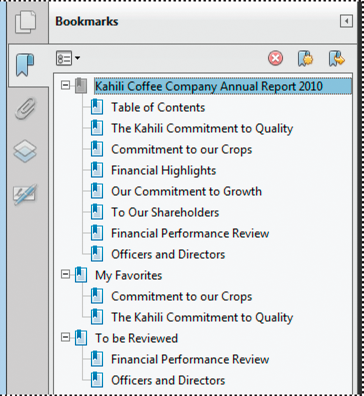
A bookmark is a type of link with representative text in the Bookmarks panel in the navigation pane. Each bookmark goes to a different view or page in the certificate. Bookmarks are generated automatically during PDF creation from the table-of-contents entries of documents created past most desktop publishing programs. These bookmarks are ofttimes tagged and tin can be used to make edits in the PDF.
Initially, a bookmark displays the page that was in view when the bookmark was created, which is the bookmark's destination. In Acrobat, you lot can set bookmark destinations as yous create each bookmark. Nevertheless, information technology is sometimes easier to create a group of bookmarks, and then set the destinations subsequently.
In Acrobat, you can use bookmarks to marker a place in the PDF to which you lot want to return, or to jump to a destination in the PDF, another document, or a web folio. Bookmarks can also perform actions, such as executing a menu item or submitting a form.
An Acrobat user can add together bookmarks to a document only if the security settings permit information technology.
Create a bookmark
-
Click the Bookmarks push button on the left to open the Bookmarks panel.
-
Open the page where you desire the bookmark to link to, and adjust the view settings.
-
Utilize the Select tool
 to select the area of the folio y'all want to bookmark:
 -
To bookmark a unmarried prototype, click in the paradigm or elevate a rectangle effectually the image.
-
To bookmark a portion of an paradigm, drag a rectangle around the portion.
-
To bookmark text, drag to select it. The selected text becomes the label of the new bookmark. You can edit the label.
-
-
Select the bookmark under which you want to identify the new bookmark. If you don't select a bookmark, the new bookmark is automatically added at the stop of the listing.
-
Choose Tools > Edit PDF > More > Add Bookmark.
-
In the Bookmarks console, type or edit the name of the new bookmark.
Edit a bookmark
In Reader, y'all can brand bookmarks easier to read by irresolute their text appearance.
In Acrobat, you can change a bookmark's attributes at whatever fourth dimension.
Rename a bookmark
-
Select the bookmark in the Bookmarks panel, choose Rename Bookmark in the options carte
, and blazon the new bookmark name.
Wrap text in a long bookmark
-
Click the Bookmarks button, and cull Wrap Long Bookmarks from the options bill of fare
. All the text of long bookmarks shows regardless of the width of the navigation pane. (This option is on when checked, and off when not checked.)
Change the text appearance of a bookmark
Y'all can alter the advent of a bookmark to describe attention to information technology.
-
In the Bookmarks panel, select one or more bookmarks.
-
(Acrobat but) To change the color and style of the text, cull View > Show/Hibernate > Toolbars Items > Properties Bar.
After you accept defined a bookmark'south advent, you can reuse the advent settings. To practice this, select the bookmark and from the options menu
, choose Use Current Appearance As New Default. -
To alter the font size, from the options menu
, choose Text Size > [size].
Modify a bookmark's destination
-
In the Bookmarks panel, select the bookmark.
-
In the document pane, motility to the location yous desire to specify as the new destination.
-
If necessary, suit the view magnification.
-
Choose Set Bookmark Destination in the options menu
. The Set Bookmark Destination option is context sensitive. It appears only when you have an existing bookmark selected.
Add together an activity to a bookmark
-
In the Bookmarks panel, select a bookmark.
-
From the options menu
, choose Properties. -
In the Bookmark Properties dialog box, click Deportment.
-
Cull an action from the Select Action menu, and click Add.
Set the default zoom level for bookmarks
Applicable to Acrobat Pro DC and Acrobat Std DC
-
In the Bookmarks panel, click the Options menu
.
-
Click Set Default Bookmark Zoom Level, and cull the desired zoom level. By default, the Inherit Zoom option is selected.


Modify the page number while adjusting the zoom level of multiple bookmarks
When you adjust the zoom level of multiple bookmarks, the destination page number for the selected bookmarks is retained by default.

To alter the destination page number of the bookmarks, do the following:
-
Select two or more than bookmarks that you want to change the zoom level.
-
Right-click the bookmark and then cull Properties.
-
In the Bookmark Backdrop dialog, click Actions.
-
Choose Go To A Page In This Certificate and then click Edit.
-
Uncheck the option Keep Page Number Unchanged.
Delete a bookmark
-
In the Bookmarks panel, select a bookmark or range of bookmarks, and then press Delete.
Deleting a bookmark deletes whatsoever bookmarks that are subordinate to information technology. Deleting a bookmark does not delete any document text.
Create a bookmark hierarchy
You can nest a list of bookmarks to show a relationship between topics. Nesting creates a parent/child relationship. Y'all tin can expand and collapse this hierarchical list as desired.
Nest one or more bookmarks
-
Select the bookmark or range of bookmarks you desire to nest.
-
Drag the icon or icons straight underneath the parent bookmark icon. The Line icon
 shows the position of the icon or icons.
 The bookmark is nested; notwithstanding, the bodily page remains in its original location in the document.

Nesting a bookmark (left), and the effect (right)
Move bookmarks out of a nested position
-
Select the bookmark or range of bookmarks you want to move.
-
Move the selection by doing ane of the following:
-
Drag the icon or icons, positioning the arrow directly under the characterization of the parent bookmark.
-
Choose Cut from the options menu
, select the parent bookmark, and then cull Paste Under Selected Bookmark from the options menu.

Moving a bookmark out of its nested position (left), and the consequence (right) -
Expand or plummet all height-level bookmarks
-
From the options menu
, choose Aggrandize Pinnacle-Level Bookmarks or Collapse Top-Level Bookmarks.
Add tagged bookmarks
Tagged bookmarks give you lot greater control over page content than do regular bookmarks. Because tagged bookmarks use the underlying structural information of the document elements (for example, heading levels, paragraphs, table titles), you can use them to edit the document, such as rearranging their corresponding pages in the PDF or deleting pages. If you motion or delete a parent tagged bookmark, its children tagged bookmarks are moved or deleted along with it.
Many desktop publishing applications, such as Adobe InDesign® and Microsoft Give-and-take, create structured documents. When you catechumen these documents to PDF, the structure is converted to tags, which support the addition of tagged bookmarks. Converted web pages typically include tagged bookmarks.
If your document doesn't include tags, you can always add them in Acrobat.
-
In the Bookmarks console, choose New Bookmarks From Construction from the options menu
. (If this option isn't bachelor, the document isn't structured.) -
Select the structure elements you lot want specified every bit tagged bookmarks. Ctrl-click to add to the selection.
The tagged bookmarks
 are nested nether a new, untitled bookmark.
Source: https://helpx.adobe.com/acrobat/using/page-thumbnails-bookmarks-pdfs.html
0 Response to "How to Draw Floor Plans in Indesign"
Post a Comment