Cooking Times for Grass Fed Beef
Treat your tastebuds to an upstanding banquet: grill upward some grass fed! Y'all'll probably pay a little more for your t-bones, just you'll be supporting small-scale farmers and those who use the most planet-friendly methods of raising livestock possible. In fact, if you support truly well-managed grass fed beef farmers, you don't demand to experience guilty at all.
But in the concurrently, yous probably need some pointers on how to treat your premium, pasture-raised porterhouse cuts or filet mignons. Grass fed beefiness is a different animal than your bargain-priced grocery store steak. Here to help you cook it to perfection is farmer and cookbook author Shannon Hayes.
The following is a collection of recipes from cookbooks by Shannon Hayes.
How to Melt the Perfect, Tender, Grass Fed Steak
The simplest, most commonly heard stardom made between grassfed and manufactory-farmed meat is that grassfed is leaner. Equally we've just seen, that is not always the instance. The real divergence lies in the fact that, by virtue of a beef animal's active and salubrious life, there is truthful musculus integrity in the meat. This is wildly different from the feedlot animals, which become little or no exercise, resulting in more than flaccid (and, hence less flavorful) cuts. This does not mean that grassfed steaks are less tender – on the contrary. Cooked more than gently, grassfed meat is wonderfully tender. The salubrious muscle texture does, still, mean that grassfed steaks volition be more variable than grainfed meats. Taste and texture of steaks will vary based on breed, farming practices, pastures, and individual animal characteristics. Thus, the flim-flam to cooking a delicious steak is to piece of work with the variability and take advantage of that beautiful muscle quality.
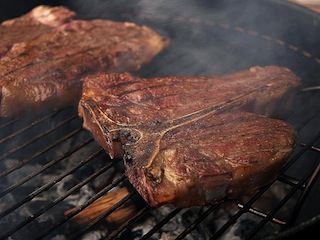 Nosotros should be treating this meat as "tenderly" in the kitchen or on the grill as the farmers treated the animals in the fields. When cooking a grassfed steak, we desire to achieve a delicious sear that creates a pleasant light crust on the exterior of the meat, then allow it to finish cooking at a much lower temperature; this allows the naturally-occurring sugars to caramelize on the surface, while protecting those muscle fibers from contracting too apace. Tough grassfed steaks result from over-exposure to high heat, which causes the muscle fibers to contract tightly and become chewy and overly dry out.
Keeping these principles in listen, beneath are 2 techniques for cooking a fantastic steak, using the same seasonings. The get-go technique, taken from The Farmer and the Grill, is for working outdoors with open flames, my preferred method, YEAR Round. If y'all program on winter grilling, exist sure to bank check out the list of tips for safe winter grilling that appear at the finish of this commodity.
The second technique is taken from my newest cookbook,Long Mode on a Piffling: An Earth Lovers' Companion for Enjoying Meat, Pinching Pennies and Living Deliciously. Much to my surprise, not every family on the Northward American continent has access to an outdoor grill – difficult to believe! Thus, in an try to include y'all in the thrill that comes from eating the all-time-tasting steak available, I've included an indoor steak recipe that guarantees your grassfed meat volition remain tender and juicy. Savour!
The Best Steak – Outdoors
Recipe adapted from Farmer and the Grill: A Guide to Grilling, Barbecuing and Spit-Roasting Grassfed Meat…and for saving the planet, one bite at a time, by Shannon Hayes
(The corporeality of seasoning yous will utilize will vary based on the size of your steak. If it is shut to one pound, employ less. If information technology is closer to ii pounds, use more.)
Ingredients
- 1-two tablespoons coarse salt
- 1-two teaspoons ground black pepper
- 1-2 cloves garlic, minced
- Either 1 sirloin, sirloin tip, tri-tip, top circular or London Bake, rib center, porterhouse, t-bone, acme loin (NY Strip) or tenderloin (filet mignon) steak. Steaks should be at to the lowest degree 1 ¼ – 1 ½ inches thick.
Process
- Combine the salt, pepper and garlic in a small basin. Rub the mixture into both sides of the steak, then allow the meat to come to room temperature while you prepare the grill.
- Start the grill and warm it until it is hot. If you are using a gas grill, plough off all only one of the burners once it has come up up to temperature. If you are using charcoal, be certain all the coals have been raked to i side. Employ the manus test: the grate will be hot enough when you can concord your palm 3-4 inches in a higher place the metal for no more three seconds.
- Sear the steaks for 2-iii minutes on each side directly over the flame, with the lid down. Then, move the steaks to the part of grill that is not lit. Set the lid in place and allow the steaks to cook, without flipping them, until they reach 120-135 degrees**, almost 10-20 minutes, depending on the size of the steak. Remove the steaks to a platter and permit them to residual a few minutes before serving.
The Best Steak – Indoors
Recipe taken fromLong Manner on a Little: An Earth Lovers' Companion for Enjoying Meat, Pinching Pennies and Living Deliciously, by Shannon Hayes
(The amount of seasoning you will use will vary based on the size of your steak. If information technology is shut to one pound, utilize less. If it is closer to 2 pounds, employ more.)
Ingredients
- 1-2 tablespoons coarse salt
- one-2 teaspoons ground blackness pepper
- 1-ii cloves garlic, minced
- ii tablespoons butter, tallow or rendered lamb fat
- Either 1 sirloin, sirloin tip, tri-tip, pinnacle round or London Bake, rib eye, porterhouse, t-bone, acme loin (NY Strip) or tenderloin (filet mignon) steak. Steaks should be at least 1 ¼ – ane ½ inches thick.
Procedure
- Combine the common salt, pepper and garlic in a small basin. Rub the mixture into both sides of the steak and then allow the meat to come up to room temperature.
- Preheat the oven to 200°, and then estrus a large cast atomic number 26 skillet or other oven-proof skillet over a high flame. Once the skillet is so hot that y'all tin run across a trivial smoke ascent off of it, add the butter or fat. Sear the steak for two minutes on each side.
- Turn off the flame, and insert an instant-read meat thermometer into the boneless edge of the steak – do not insert information technology into the top, as there is not enough thickness for the thermometer to take an accurate reading.
- Leaving the steak in the skillet, place information technology in the oven and permit it to stop cooking, about 10-20 minutes depending on the size of the cut, until the internal temperature reads 120-135°. Allow the meat to rest five minutes before etching and serving.
Weren't aware that grassfed meats have different internal doneness temps than grainfed? Get a handy magnetic grassfed temperature guide, the Don't Overdo It Magnet, from grassfedcooking.com. They're inexpensive, and y'all can experience skillful about them, because they are made by a pocket-size, locally owned factory in my community.
 Winter Grilling Tips
Yes, the indoor method described to a higher place is terrific. The meat is super-tender and juicy. But I prefer to season with a niggling smoke and flame. Thus, I've become one of those hard-core advocates of yr-round grilling. If y'all are new to the thought, hither are a few tips to get y'all started.
-
Cull a safe place for grilling outdoors. The garage may not be your best bet, since it probably contains a few explosives, such as cans of gas, or backyard mowers, chainsaws or other vehicles that contain gasoline. I actually have a screened-in porch with a brick floor that shelters me for winter grilling. That's a little more deluxe than most folks have – just try to choose a sheltered spot that isn't besides close to your house.
-
Keep the path to your grill site, and the area around it, free of snow and ice. It would be deeply annoying to ruin a perfectly good dinner because of a last-minute trip to the emergency room.
-
Wearing apparel wisely. I discover that my charcoal throws upwards a lot more sparks in the winter…or perchance I've simply noticed them more than, because I've made the stupid mistake on occasion of wearing drapey and flammable garments, such as wintertime scarves, out to the coals. Learn from my experience, and don't brand the same stupid mistake.
-
Limit your grilling repertoire. It's cold out. Barbecuing is a culinary tradition from the warm s. Unless you lot have some pretty sophisticated equipment, and are some kind of BBQ Macho-Homo (you know who you are), smoking and barbecuing are best relegated to summer pleasures. Stick to the steaks, burgers and chops. They minimize the trips out to the grill, keeping the common cold out of your house and out of your basic.
- Allow extra rut-upward and cook times. Extreme outdoor temperatures will affect the warm-up and cooking time of your grill. To adapt for this, always grill with the lid downwardly, and monitor the internal temperature of your meat with an instant-read meat thermometer. If you are because buying a gas grill and you program to use it through the winter, buy the highest BTU rating y'all can beget. The common cold truly slows the rut-upward process. Too, loftier BTUs frequently accompany higher quality grills, which will practice a meliorate task holding in the rut during the winter months. If y'all are on a budget (like me) or just prefer the flavor (like me), a elementary little Weber charcoal kettle volition work beautifully for outdoor wintertime grilling (no, I do non work for them).
Wintertime grilling is much easier if you are working with the ecologically responsible charwood (available in many hardware or natural food stores) considering it is much easier to light, and information technology apace gets a lot hotter than blended briquettes. I find that, with the exception of the most extreme weather atmospheric condition, I can keep to my normal cook times by simply using a few more coals in the fire. The bonus is that charwood is better for the planet.
For more than tips on ecologically responsible grilling, check out my book, The Farmer and the Grill: A Guide to Grilling, Barbecuing and Spit-Roasting Grassfed Meat…And for saving the planet, i bite at a fourth dimension.
Shannon Hayes is the host of grassfedcooking.com and radicalhomemakers.com. She is the author of Radical Homemakers, Farmer and the Grill, and The Grassfed Gourmet. Hayes works with her family unit producing grassfed and pastured meats on Sap Bush Hollow Farm in Upstate New York.
Recommended Reads
Preparing and Cooking Rabbit
RECIPE: Grilled Nopalitos with Herbs and Cotija
Source: https://www.chelseagreen.com/2021/how-to-cook-the-perfect-tender-grassfed-steak/
0 Response to "Cooking Times for Grass Fed Beef"
Post a Comment